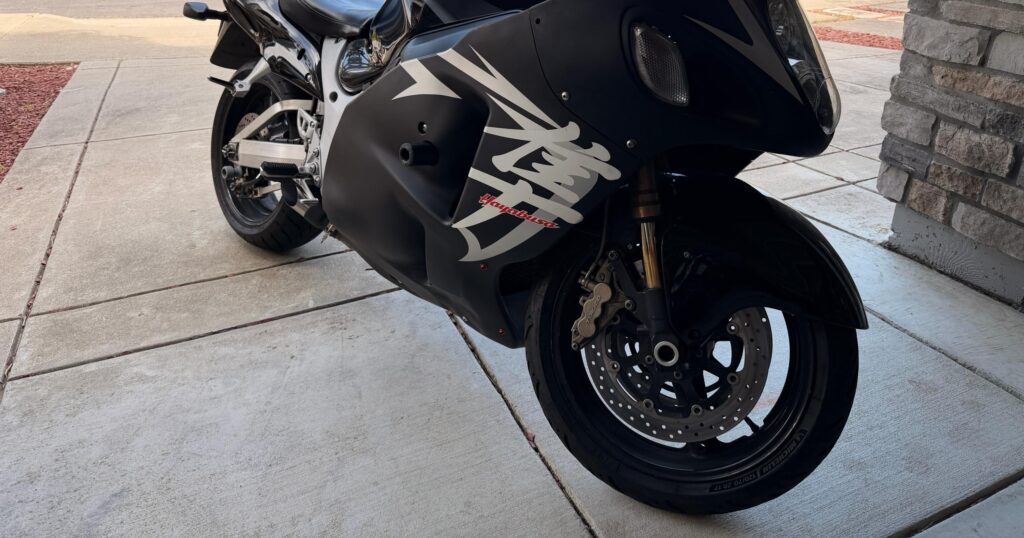
Everybody warned me about the power.
Friends who ride, friends who don’t, guys at gas stations, the internet at large — the message was consistent. The Hayabusa is the fast one. The 300-kilometer-per-hour one. The one they had to make an agreement about. The subtext was always the same: be careful, that thing will get away from you.
Nobody warned me about the other thing, which turned out to be much stranger.
You start it. You ease out the clutch. You ride through traffic. Nothing happens. It doesn’t lunge. It doesn’t snap at you. It doesn’t feel like a barely contained explosion. At 35 mph in third gear, a first-generation Hayabusa is one of the most uneventful motorcycles I’ve ever experienced. It just… goes. Smoothly. Quietly, even.
And somewhere in that quiet, I started to understand why this motorcycle has such a confused reputation. People who have never ridden one imagine an untamable monster. People who have ridden one often say it’s surprisingly easy. Both are telling the truth. The interesting part — the part I want to write about — is how those two truths fit together.
Where the reputation came from
A quick bit of history, because it explains everything downstream.
In the late 1990s, the big Japanese manufacturers were in an open top-speed competition. Kawasaki’s ZX-11 had held the production top-speed crown, then Honda took it with the CBR1100XX Super Blackbird. Suzuki wanted it next, and they didn’t want to win by a rounding error.
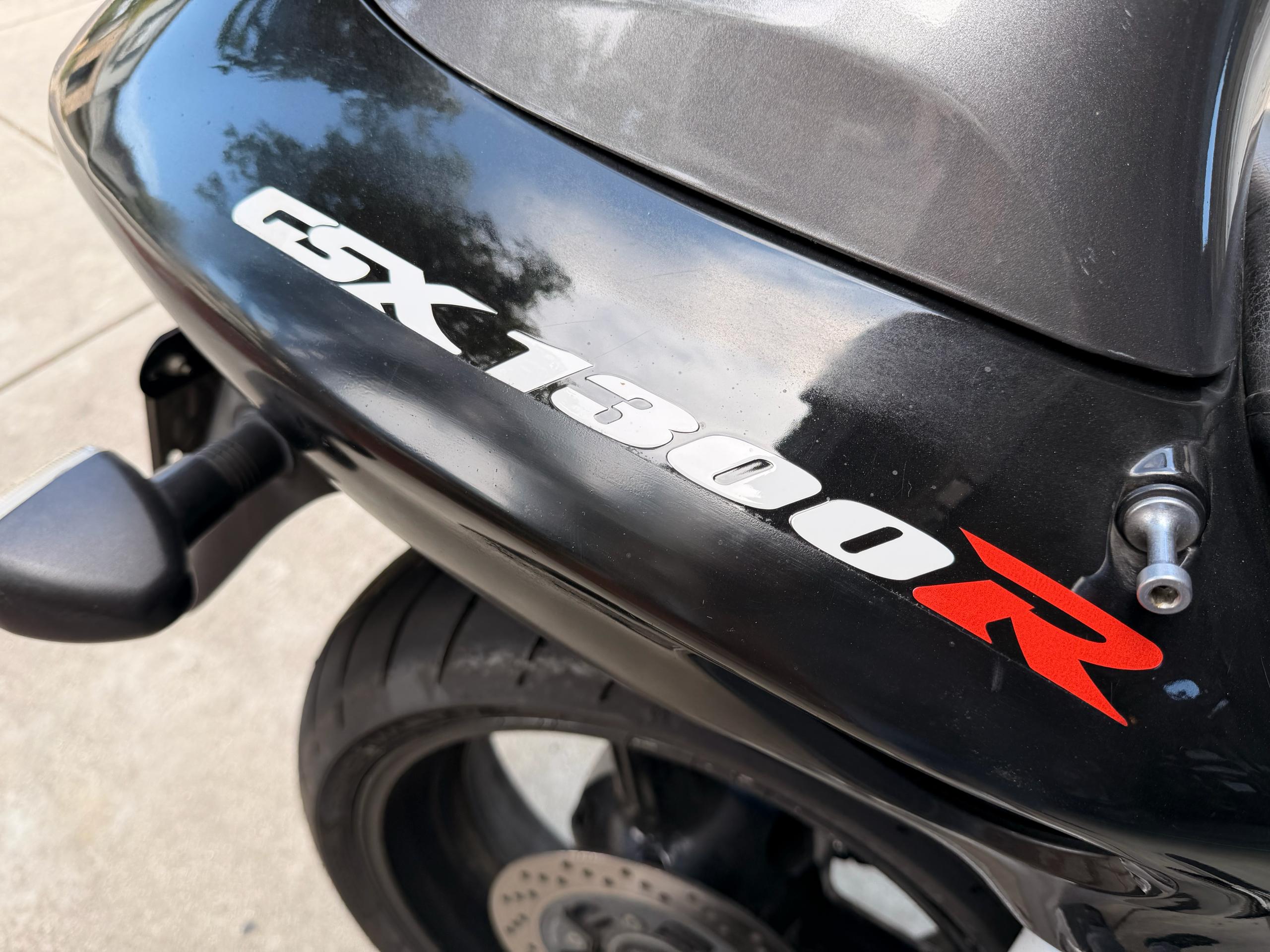
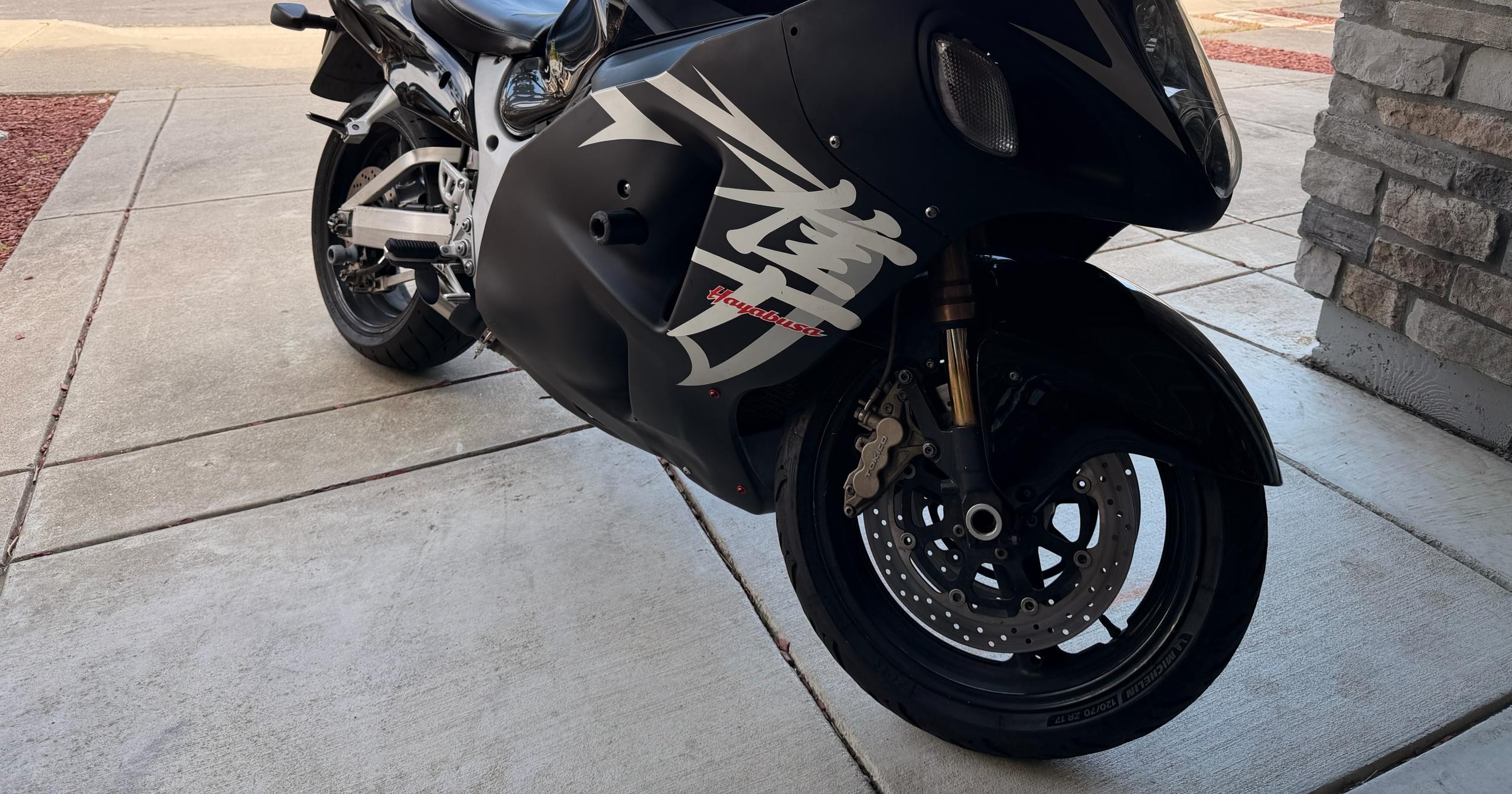
The result, launched in 1999, was the GSX1300R. Suzuki named it Hayabusa, the Japanese word for the peregrine falcon — the fastest animal on earth in a dive, and a bird that happens to hunt blackbirds. Subtle, Suzuki. Very subtle.
The first Hayabusa was reportedly the first production motorcycle to genuinely approach the 190 mph range in independent testing. That number caused enough alarm — including talk of European regulators stepping in — that the major manufacturers reached an informal understanding to electronically limit future motorcycles to 300 km/h, roughly 186 mph. This is the famous “gentlemen’s agreement.” It was never a formal treaty and the details are murkier than forum lore suggests. But the practical upshot is real: the earliest Hayabusas sit right at the peak of the unrestricted top-speed era, and nothing since has been allowed to openly chase that crown the same way.
So the bike became a legend before most people ever sat on one. Fastest production motorcycle in the world. The one that ended the speed wars. From there, culture did what culture does: drag racers stretched them, tuners turbocharged them, the internet turned them into memes, and “Hayabusa” became shorthand for too much motorcycle.
Here’s what got lost in all of that: what the engineers actually built.
Wait — why is this thing so easy to ride?
Suzuki’s design brief for the Hayabusa was a concept they called “Ultimate Sport”. The idea wasn’t a razor-edged track weapon. It was a motorcycle that combined enormous performance with aerodynamics, stability, and real-world usability — something you could ride far, ride daily, and ride very, very fast if you had somewhere legal to do it.
That intent is all over the bike once you’re paying attention. The wheelbase is long. The bodywork — the bulbous, wind-tunnel-first styling everyone made fun of in 1999 — exists to keep the thing planted and the rider out of the blast. The riding position is committed but not cruel; it’s roomier and less wrist-punishing than a proper supersport. The engine, a 1300cc inline four, makes so much torque across so much of the rev range that the bike never needs to be worked.
And that last point is the one that rearranges your brain.
On a smaller motorcycle, strong acceleration is something you have to assemble. You need the right gear, a downshift or two, revs in the meaty part of the range, a deliberate throttle hand. Acceleration is an event you plan.
On the Hayabusa, acceleration is just… ambient. It’s always there, in any gear, at any rpm, available with a lazy quarter-turn of the wrist. Overtaking doesn’t require preparation. Merging doesn’t require a plan. The engine barely changes its tone of voice. What surprised me most in ordinary riding isn’t the power — it’s how little the bike asks of me to access it. Fewer shifts. Fewer decisions. Less drama.
Combine that with the long, stable chassis and the smooth fueling, and you get a genuinely weird sensation: one of the most infamous motorcycles ever built, trundling through town, feeling about as threatening as a well-broken-in commuter. There’s a moment every Hayabusa rider seems to have, and I had it too: Wait. That’s it?
That moment is worth examining, because it’s exactly where the danger lives.
Easy is not the same as forgiving
Motorcycle culture has a long-running joke: “a turbo Hayabusa is the perfect beginner bike.” Yammie Noob, a big motorcycle YouTuber, built a whole video around a version of this in 2020 — he put a beginner rider on his Hayabusa to see what would happen. And the honest answer, which is the whole reason the video is interesting, is: not much. A careful novice can physically operate a Hayabusa around a parking lot and down a road. The controls work like any motorcycle’s controls. The power delivery at small throttle openings is gentle. Nobody explodes.
The joke exists because of that gap — because the scariest-sounding motorcycle in the world is, at the level of basic operation, almost anticlimactic. That’s the punchline.
But “a beginner can operate it” and “it’s appropriate for a beginner” are answers to two completely different questions, and the difference between them is the most useful idea I’ve taken from this bike.
Easy to operate means the machine responds smoothly and predictably to correct inputs. The Hayabusa absolutely does.
Forgiving means the machine responds gently to incorrect inputs. And that’s a different property entirely.
Think about what a mistake actually is on a motorcycle. A beginner gets startled and rolls on a little too much throttle. On a small bike, that mistake produces a modest surge — noticeable, correctable, educational. On a Hayabusa, the same wrist movement produces a dramatically larger result, because the machine amplifies every input. The input was identical. The margin for error was not.
Run down the list of ordinary riding situations and the pattern repeats. Entering a corner slightly too fast: on a light 400, you’re carrying a little extra speed; on a Hayabusa, “slightly too fast” arrived much more quickly and there’s a lot more mass to manage. A freeway on-ramp where you meant to reach 65 and glanced down at 90. A panic grab of the brakes. A moment of overconfidence on a road you don’t know. None of these require the bike to misbehave. The bike behaves perfectly. It does exactly what you told it to do — which is precisely the problem, because it does it bigger and faster than you meant.
The Hayabusa doesn’t punish you for being on it. It punishes errors at a higher exchange rate.
The dangerous part might be how calm it feels
There’s a second layer to this, and I think it’s the more insidious one.
Some motorcycles narrate their speed. They vibrate, they buzz, they get frantic, the wind starts tearing at you, and your body receives a continuous stream of messages saying we are going quite fast now. That feedback is annoying, but it’s also information.
The Hayabusa was engineered to delete those messages. That was the point. Stability at speed wasn’t a side effect; it was the design target. The long wheelbase resists pitching and weaving. The aerodynamics smooth the air around you. The engine turns lazily where other bikes scream. Period reviewers noted it, and riders have repeated it for twenty-five years: the Hayabusa is eerily composed at speeds that are, by any reasonable standard, unreasonable.
Which means the feeling of speed and the fact of speed come apart. Humans judge velocity substantially through sensation — noise, vibration, wind, chaos. Remove the sensations and the speedometer becomes the only honest witness. One thing I noticed quickly: on this bike, checking my speed is not optional. Not because it runs away on its own — it doesn’t — but because my gut’s estimate is consistently, sometimes comically, low. The bike is calm at seventy the way other bikes are calm at forty-five, and my nervous system happily accepts the trade.
A machine that hides speed from your instincts isn’t malfunctioning. But it quietly transfers a job to you — conscious speed monitoring — that louder motorcycles do for free. New riders don’t know that job exists. Experienced riders do it out of habit. That, right there, is most of the difference.
Slow speed is where the weight shows up
Here’s the part nobody puts in the memes: the place a Hayabusa most often bites people isn’t at 150 mph. It’s at 2 mph.
Once it’s rolling, the bike’s mass essentially disappears — gyroscopic forces and good chassis geometry hold it up, and it steers with an ease that seems illegal for something this size. But motorcycle weight isn’t a constant experience. It’s a function of speed. As you slow toward walking pace, the physics stop helping and your legs take over the job, and the Hayabusa is a heavy motorcycle by any measure.
U-turns. Sloped parking spots. Backing it out of a garage. Stopping with the bars turned and the road crowned the wrong way. Paddling it backward on gravel. These are the moments when a tall, heavy, faired motorcycle reminds you that the wind tunnel doesn’t care about parking lots. The weight becomes much more obvious when the speed approaches zero, and once a bike this size leans past the point where your leg can catch it, it’s going down, and there is nothing your throttle discipline can do about it.
I find this genuinely clarifying, because it separates two skills people conflate. Managing a Hayabusa’s engine is mostly a matter of restraint. Managing a Hayabusa’s mass is a matter of technique — clutch and rear-brake control, head position, planning your stops — and technique only comes from practice on something you can afford to practice on.
A motorcycle from before the computer started watching you
The first-generation Hayabusa ran, with modest updates, from 1999 through 2007, and it comes from a distinct era of performance motorcycles: modern enough to have fuel injection, sorted reliability, and sophisticated aerodynamics — old enough to predate the electronic-rider-aid revolution almost entirely.
Depending on year and market, there is no traction control here, no cornering ABS, no wheelie control, no ride modes, no IMU quietly measuring your lean angle a hundred times a second. The throttle is a cable connected to your wrist. Traction management happens through your hands, your eyes, and your judgment.
I want to be careful here, because this is where motorcycle writing usually collapses into one of two dumb takes. The first is “old bikes are dangerous.” The second is “real riders don’t need electronics.” Both are wrong, and the second one is worse.
Modern rider aids are excellent. They save people constantly, mostly in moments those people never even notice. What riding a pre-electronic bike actually teaches you is not that you’re a purer rider — it’s how much responsibility those systems have been quietly absorbing on newer machines. On a current-generation bike, a clumsy throttle input mid-corner gets filtered through software before it reaches the rear tire. On a Gen 1 Hayabusa, it reaches the rear tire as written. The bike executes your instructions faithfully, including the bad ones.
That produces a different relationship with the machine. Not better. Different — more direct, more demanding of attention, and honestly kind of absorbing, the way manual anything is absorbing. You’re aware that you are the traction control.
Why experienced riders love these things
Here’s a wrinkle that took me a while to appreciate: for a skilled rider, the Hayabusa isn’t just manageable — in some ways it’s genuinely easier than smaller machinery.
An experienced rider with a smooth right hand gets to enjoy everything the torque gives: relaxed engine speeds, effortless passing, almost no shifting, a chassis that never gets nervous, and all-day stability on the highway. A 600cc supersport demands revs, aggression, and constant gear-changing to deliver its performance; it nags you into riding hard. The Hayabusa demands nothing. It’ll do 400 highway miles at a loping rpm and feel like it’s napping. That’s the “Ultimate Sport” idea working exactly as intended.
Which explains the least glamorous, most under-reported fact about this motorcycle: mostly, people just ride them. They commute on them. They bolt luggage to them and tour. They rack up six-figure odometers and keep them for decades. The stretched-swingarm drag builds and turbo monsters are real, but they’re the caricature. Underneath the caricature is a fast, stable, comfortable, weirdly practical machine — closer to a very athletic sport-tourer than to the widowmaker of legend. I’m starting to understand why owners hold onto these things for so long.
Why I still wouldn’t call it a beginner bike
So let’s answer the joke honestly.
Could a beginner ride a Hayabusa around town without incident? Plenty could, probably. The bike would not stop them. That’s precisely what the Yammie Noob experiment demonstrated, and what the whole “surprisingly easy” chorus has been saying since 1999.
Should they? I don’t think so, and not for the reason the memes give.
The argument isn’t “beginners can’t handle horsepower.” Beginners aren’t reckless idiots; they’re just people who haven’t collected enough situations yet. Riding skill is a library of automatic responses — to gravel appearing mid-corner, to a decreasing-radius turn, to a car turning left across your path, to a wind gust, to traffic stopping dead where it shouldn’t. You cannot think your way through these events in real time. The response has to already be in your hands, and it only gets there through repetition, including repetitions where you get it slightly wrong.
That’s what a smaller, lighter, less powerful motorcycle actually offers a new rider. Not weakness. Cheaper mistakes. Room to get things imperfect while the library fills in.
And “just respect the bike” doesn’t close the gap, however sincerely it’s meant. Respect is an attitude. Riding is a physical skill. A rider can hold a Hayabusa in genuine reverence and still grab a fistful of front brake in a panic, still target-fixate on the thing they’re trying to miss, still drop it on a downhill U-turn. The bike doesn’t grade you on your attitude. It grades you on your inputs.
What I’m learning from it
The Hayabusa taught me that a motorcycle doesn’t have to feel difficult to demand experience.
I used to assume those were the same thing — that danger would announce itself, that the machine at the far end of the performance spectrum would feel like the far end of the spectrum. It doesn’t. At normal speeds this bike is smooth, stable, and strangely friendly, and that’s not false advertising; it’s the actual brilliance of the design. Suzuki set out to make extraordinary speed usable, and they succeeded so thoroughly that the speed stopped feeling extraordinary.
Which is exactly why a new rider could get comfortable on one far faster than they could get genuinely skilled on one. Comfort takes an afternoon. Skill takes years. On most motorcycles the gap between those two is annoying and obvious. On a Hayabusa the gap is silent — and it’s the silence, not the horsepower, that deserves the reputation.
There’s a real difference between being able to operate a motorcycle and being ready for everything that motorcycle can do. Every bike has that gap. The Hayabusa just makes it unusually easy to see.
I keep thinking about that on ordinary rides, at ordinary speeds, on this supposedly terrifying machine that has yet to do a single terrifying thing I didn’t ask it to do. The falcon, it turns out, is a very calm bird. Right up until it isn’t — and choosing when it isn’t is entirely, unnervingly, up to you.
A few quick sidebars for the curious:
Why “Hayabusa”? It’s Japanese for the peregrine falcon, the fastest creature alive — capable of well over 200 mph in a hunting dive. Peregrines also prey on blackbirds. The reigning speed king when Suzuki was developing this bike was Honda’s CBR1100XX Super Blackbird. Engineers are not above trash talk.
What does “Gen 1” mean? Hayabusas come in three generations: the original (1999–2007), the second (2008–2020), and the third (2021 onward). Gen 1 is the original unrestricted-era design; later generations added displacement, refinement, and eventually the full modern electronics suite.
Hypersport or sport-tourer? People have argued about the Hayabusa’s category since day one. It’s built like a superbike but sized, shaped, and geared like something meant to cross continents. The honest answer is that Suzuki deliberately built it between categories, and the ongoing argument is evidence they succeeded.
Why do long wheelbases feel stable? The farther apart the wheels, the more the bike resists pitching under power and braking and the slower it reacts to steering inputs and road irregularities. That’s why the Hayabusa tracks like it’s on rails at speed — and why it asks for a bit more effort in tight, flip-flop corners than a short, nervous supersport.
Why does torque change street riding? Horsepower determines what a bike can do at full scream; torque determines what it does the instant you open the throttle, in whatever gear you happen to be in. A high-torque engine makes strong acceleration available without downshifts or planning — wonderfully effortless, and effortlessly fast, which is exactly the double edge this whole article is about.
Why do heavy bikes get hard at walking speed? Above roughly jogging pace, a motorcycle’s spinning wheels and geometry keep it balanced with almost no input. Below that, the rider’s body does the balancing, and the physics of a tall, top-heavy machine take over: once it leans past a small angle, the leverage required to catch it exceeds what most legs can supply. Weight you never notice at 60 mph is all you notice at 2.