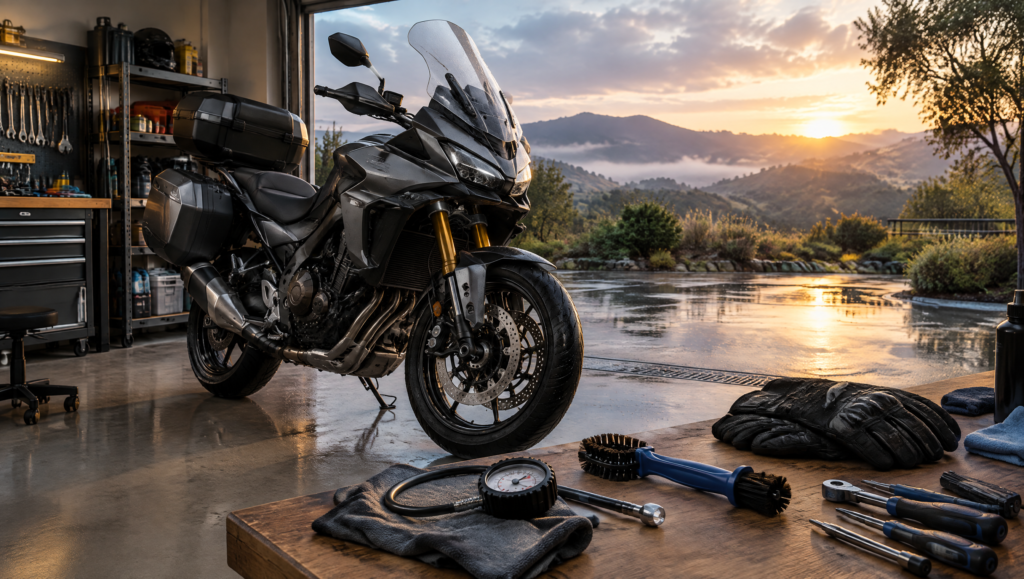
Many California riders do not put their motorcycles away for an entire winter. That does not make fall maintenance optional. Cooler mornings, rain, shorter daylight, and long dry-season mileage make this a useful moment to reset the bike before wet-season riding.
This is not a substitute for the owner’s manual or a qualified mechanic. It is a practical inspection list for deciding what you can check yourself and what needs service.
1. Start with the tires
Check pressure when the tires are cold and use the motorcycle manufacturer’s specification—not the maximum pressure molded into the tire sidewall.
Inspect both tires for:
- tread approaching the wear indicators;
- uneven or squared-off wear;
- cracks, cuts, bulges, or weathering;
- embedded objects;
- damaged valve stems; and
- signs of pressure loss.
The Motorcycle Safety Foundation’s T-CLOCS checklist calls for checking tread depth, wear, weathering, bulges, embedded objects, and cold pressure. California DMV guidance likewise requires sufficient tread and pressure for safe operation.
The four-digit date code identifies the week and year of manufacture. Age alone does not create one universal replacement date, but it belongs in the decision. Michelin recommends annual professional inspection after five years of use and replacement by ten years from manufacture, even if tread remains. Follow the tire and motorcycle manufacturers’ guidance for your specific setup.
A recent bargain-tire video was useful for highlighting sidewall checks, but not for ranking brands. Price, parent-company ownership, or a DOT mark does not establish that two tires have the same compound, construction, performance, or suitability.
2. Check brakes before the first wet ride
Inspect pad thickness, rotors, fluid level, hoses, and lever or pedal feel according to the service manual. If anything feels soft, inconsistent, or different from normal, treat that as a service issue rather than something to “ride through.”
California DMV warns that wet surfaces reduce traction and recommends gradual braking inputs. Good technique matters, but it cannot compensate for worn tires or a brake problem.
3. Clean, inspect, and lubricate the chain
For chain-drive motorcycles, check slack at the location and loading condition specified by the manufacturer. Look for stiff links, rust, damaged seals, hooked sprocket teeth, and uneven adjustment.
Cleaning and lubrication intervals vary, and wet riding can change them. Use the owner’s manual and the chain manufacturer’s instructions; do not copy a generic slack measurement from another motorcycle.
4. Check fluids, leaks, and service intervals
Verify engine oil, coolant where applicable, brake fluid, and any other service items listed for the motorcycle. Look underneath and around hoses, seals, drain points, and the engine for fresh leaks.
Fall is also a good time to check whether mileage—not the calendar—has put the bike close to scheduled service.
5. Test every light and control
Confirm the headlight, high beam, taillight, brake-light switches, turn signals, horn, and instrument warnings work. Shorter days make lighting defects more consequential.
Then inspect throttle and clutch operation, cables or hydraulic controls, mirrors, fasteners, side stand, and suspension for anything loose, sticky, leaking, or unusual.
6. Check the battery and charging condition
A motorcycle that sits longer between rides may expose a weak battery. Inspect terminals for looseness or corrosion and follow the manufacturer’s procedure for testing or charging. Use only a compatible maintainer if the bike will sit; do not assume every battery chemistry uses the same charger settings.
7. Prepare the rider, not just the motorcycle
- clear visor and anti-fog plan;
- waterproof layers that do not restrict controls;
- gloves and boots that preserve feel and grip;
- reflective or high-visibility elements;
- emergency contact and roadside plan; and
- a decision rule for conditions that are not worth riding in.
The first rain after a dry stretch can bring oil and debris to the surface. Reduce speed, increase following distance, avoid abrupt inputs, and be especially cautious around painted lines, metal covers, pooled water, and the center of the lane.
A 10-minute pre-ride version
Use T-CLOCS as the structure: Tires and wheels; Controls; Lights and electrical; Oil and other fluids; Chassis; and Stands.
A seasonal inspection should be more thorough, but this short check is useful before every ride.
From the field
My fall checklist is simple: inspect the tires and wiring, and bring rain gear just in case. It is also a good time to refresh your helmet if needed and shop for winter gear—though I usually look for that gear closer to summer.
The practical takeaway
California riders may not need a months-long storage ritual, but they still need a wet-season readiness check. Tires, brakes, controls, lights, fluids, chain condition, battery health, and rider gear all deserve attention before the first cold or rainy ride exposes a weakness.