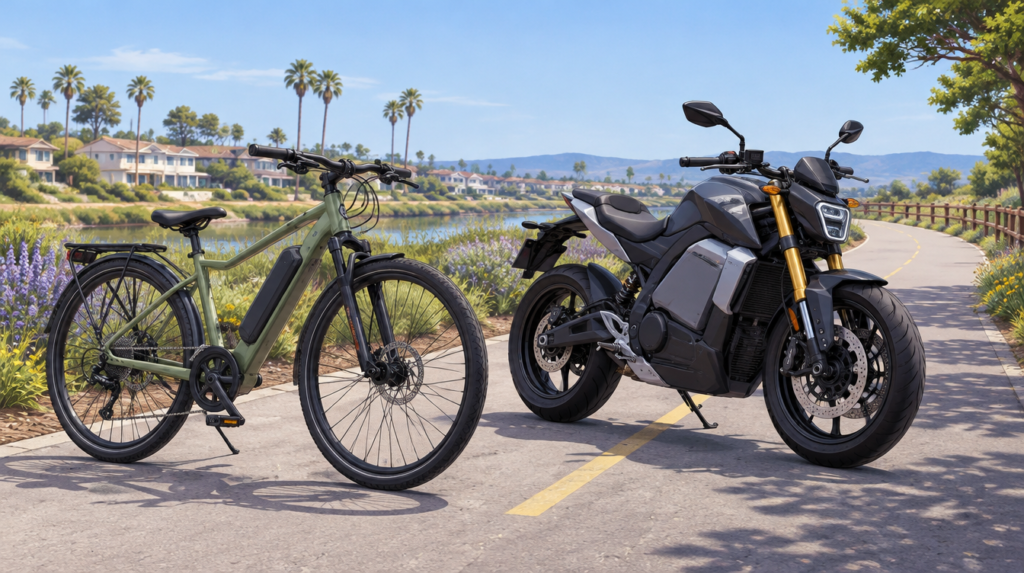
Three California e-bike bills were signed in 2026, but they do not all do the same thing. One targets the line between an e-bike and a faster e-moto; one lets San Mateo County consider a youth pilot; one covers equipment, disclosure and local speed rules. For families and buyers, the first step is knowing which vehicle and location the rule actually reaches.
News disclaimer: This is a public-source overview, not legal advice. Check current state law and local ordinances before relying on a rule for a purchase or ride.
SB 1167: identify the vehicle you are buying
SB 1167 addresses vehicles sold or advertised as e-bikes when their capabilities put them outside the ordinary e-bike category. The useful buyer question is not what a listing calls the machine; it is whether the actual power, speed and operating characteristics fit California’s e-bike definition. Ask the seller for the class and written specifications, and do not assume a faster electric motorcycle is legal wherever bicycles are allowed. This is a different issue from the site’s existing SB 586 registration explainer.
AB 2595: a local option, not a statewide ban
AB 2595 authorizes a San Mateo County pilot under which local authorities may prohibit children under 12 from operating Class 1 or Class 2 e-bikes in specified areas. Authorization is not the same as an automatically effective countywide prohibition. Parents should check whether their city or the county has adopted an ordinance and where it applies. CalMatters reports the pilot is scheduled to sunset in 2031 and describes a $25 penalty for a parent or guardian where the local rule applies.
AB 2346: equipment and speed rules have different dates
AB 2346 covers several separate changes. According to CalMatters’ summary, local governments can set signed limits of 10, 15 or 20 mph on bicycle paths and multiuse trails beginning January 1, 2027; it also describes a 10 mph prima facie limit for riding on sidewalks. Equipment and retailer-disclosure provisions take effect in 2029. Check current local signs and ordinances; these future provisions are not today’s riding rules.
A three-question pre-purchase check
- Is this actually a legal Class 1, 2 or 3 e-bike—or a faster vehicle marketed as one?
- Where will it be ridden, and what local age or speed rule applies there?
- What safety equipment and written product information will the seller provide?
From the field
I want dealers to be clear with buyers about what they are selling. If an electric two-wheeler can go faster than 20 mph, I believe its rider should have motorcycle-level training and licensing. The label on the sales floor should not hide the skill and protection that speed demands.
That is my safety recommendation, not a description of current California law. A legal Class 3 e-bike may provide pedal assistance up to 28 mph; actual licensing requirements depend on vehicle classification.
The takeaway: the bills address different problems. Do not compress them into a claim that every California child is banned from e-bikes or that every device sold as an “e-bike” is legally one.
Sources: California Legislature bill pages for SB 1167, AB 2595 and AB 2346; CalMatters.