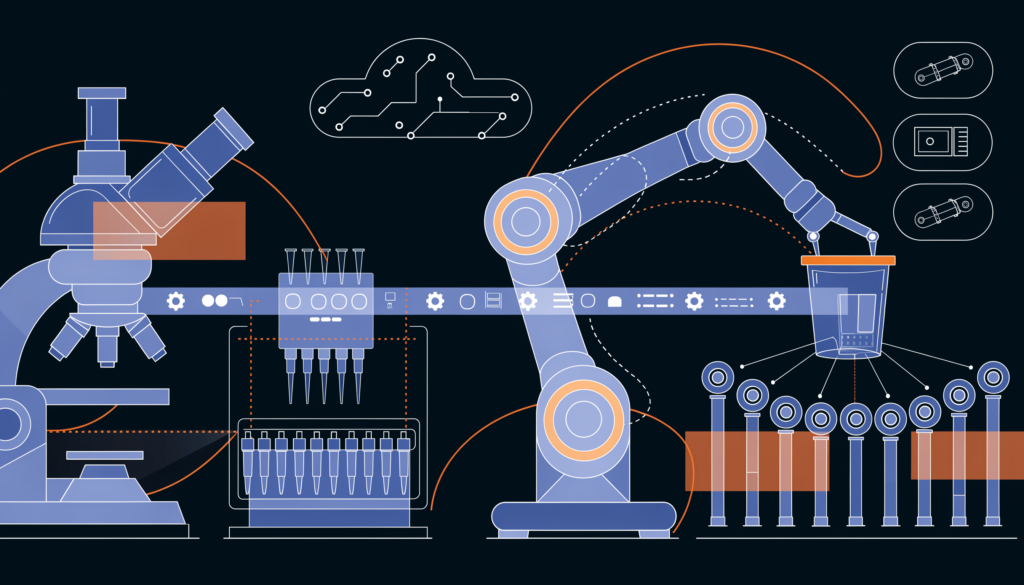
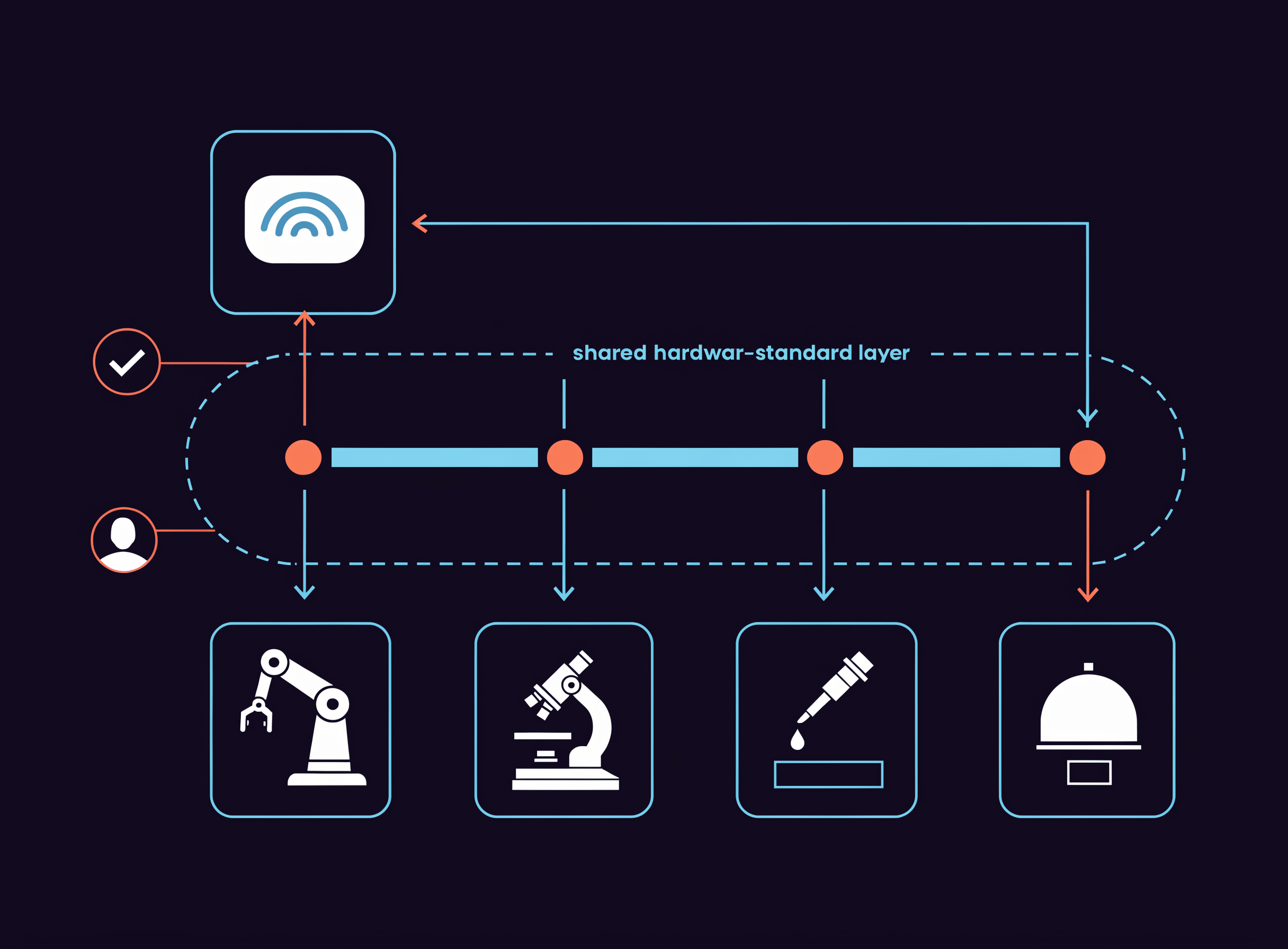
Anthropic has opened a research preview of the Model Hardware Standard, or MHS: a shared interface intended to let AI agents discover, monitor, and operate programmable physical equipment such as microscopes, liquid handlers, and robotic arms.
The important word is preview. MHS is not a broadly deployed safety standard, and the early performance examples come from Anthropic and participating partners. Still, it points toward a major governance shift: AI agents moving from software-only tasks into systems that can change the physical world.
What MHS is designed to solve
Laboratory and manufacturing devices often use different programming interfaces. Connecting them can require custom integration work for each instrument and workflow.
According to Anthropic’s announcement, MHS introduces a standardized driver with common operations such as “read” and “write.” The driver can also describe device characteristics, capabilities, and safety limits in a machine-readable form.
Anthropic says this can reduce some integrations from weeks or months to hours or minutes. That is a vendor claim from an early research preview, not an independently benchmarked industry result.
How an agent would use it
Once connected, an agent could discover compatible equipment, read operating data, sequence work across several devices, adjust parameters, and execute deterministic code for time-sensitive or long-running tasks.
MHS is described as model-agnostic and accessible through mechanisms including the Model Context Protocol, command-line tools, and APIs. CNBC independently reported the limited research-preview rollout and its model-agnostic design.
\n
The Genentech example shows both promise and limits
In Anthropic’s published case study, Genentech used MHS to coordinate a liquid handler, robotic arm, and plate reader for a protein-concentration assay. Claude adjusted liquid-handling parameters by running trials and comparing results with an expert benchmark.
The same case study also documents an important limitation. When bubbles caused hardware errors, the model initially retried the operation in ways that made the problem worse. It needed human guidance about the underlying physical cause before it could apply a better approach.
That is exactly the distinction operators should preserve: successful orchestration is not the same as reliable physical-world understanding.
The governance questions matter more than the demo
Before an organization lets an agent operate physical equipment, it should be able to answer:
- Which devices and commands can the agent access?
- Who defines and verifies safety limits?
- What happens when sensor data is wrong, delayed, or missing?
- Which actions require human confirmation?
- Can an operator stop the workflow immediately?
- Are commands, state changes, overrides, and failures logged for review?
- Can a deterministic safety controller override the model?
The strongest architecture keeps physical safety constraints outside the model’s discretion. An agent may propose or orchestrate actions, but hard limits, interlocks, and emergency stops should remain independently enforceable.
From the field
\n
Making sure sensors work (visual, touch, movement, area recognition, etc) and guardrails for the AI to understand what to do when something wrong or suspicious that requires action.
\n
The bottom line
MHS is a credible early attempt to standardize how AI agents interact with programmable equipment. It is also a reminder that “works in a pilot” is not the same as “safe at scale.” The real test will be whether access control, independent safety systems, auditability, and human intervention remain effective as the standard opens to more devices and organizations.
News disclaimer: This article summarizes public information available as of September 24, 2026. MHS remains a limited research preview; availability, capabilities, and safety practices may change.
Sources: Anthropic, “Previewing the Model Hardware Standard” (primary); Ars Technica; CNBC.