Starting August 14, if you’re on Claude Code with a Pro, Max, or Team plan, new sessions default to something called “auto mode.” In plain terms: instead of Claude stopping to ask “can I run this command?” every few seconds, it just proceeds — unless the action is irreversible, destructive, or reaches outside your project environment. Only then does it pause and check in.
That’s a real behavior change, not a UI tweak, and Anthropic backed it with data instead of just shipping it quietly. Worth unpacking, because the reasoning behind it is the more interesting story than the feature itself.
What actually shipped
Claude Code is Anthropic’s command-line coding agent — you give it a task (“fix this bug,” “add this feature”), and it writes code, runs commands, and iterates on its own. Up until now, the default behavior was to ask permission before most actions: read this file, run this script, install this package. Each one, a prompt.
Auto mode flips that default. Claude proceeds on its own for routine work, and a classifier — a small screening model — checks every action in the background for three categories: irreversible (can’t be undone), destructive (deletes or overwrites something important), or aimed outside your environment (touching something beyond the project you’re working in). If an action trips one of those wires, Claude either finds a safer path on its own or stops and asks you directly.
The rollout is Pro/Max/Team now, with Enterprise, API, and cloud-partner access (AWS, Google Cloud, Microsoft Foundry) following in the coming month once admins have had time to review it.
Why this is the pattern to watch, not the feature
Here’s the part that actually matters, and it’s not “AI can now run commands without asking.” It’s why Anthropic decided that was the safer default — and the data is uncomfortable in a useful way.
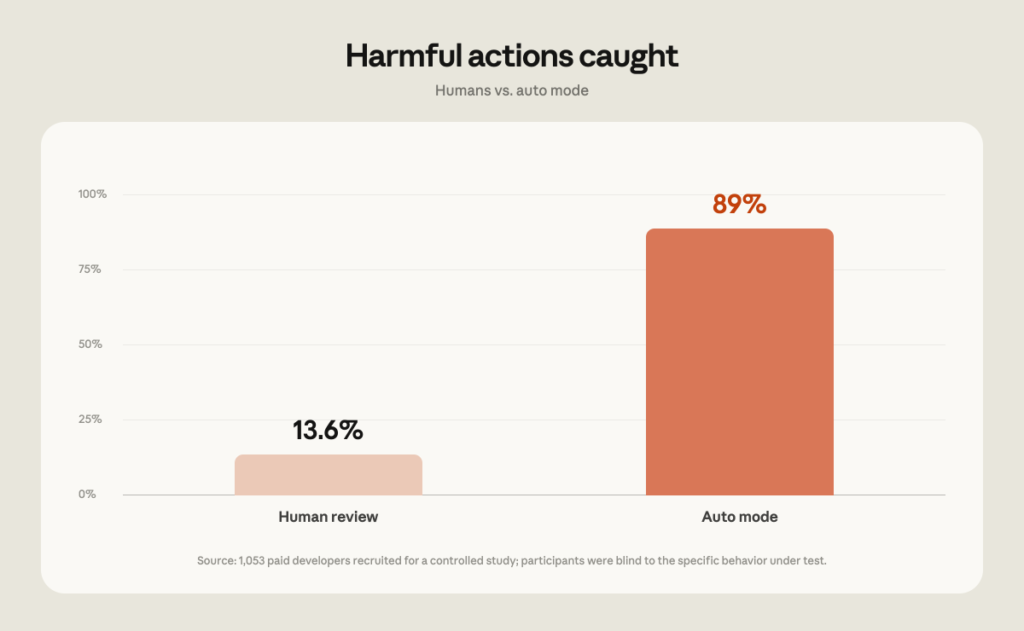
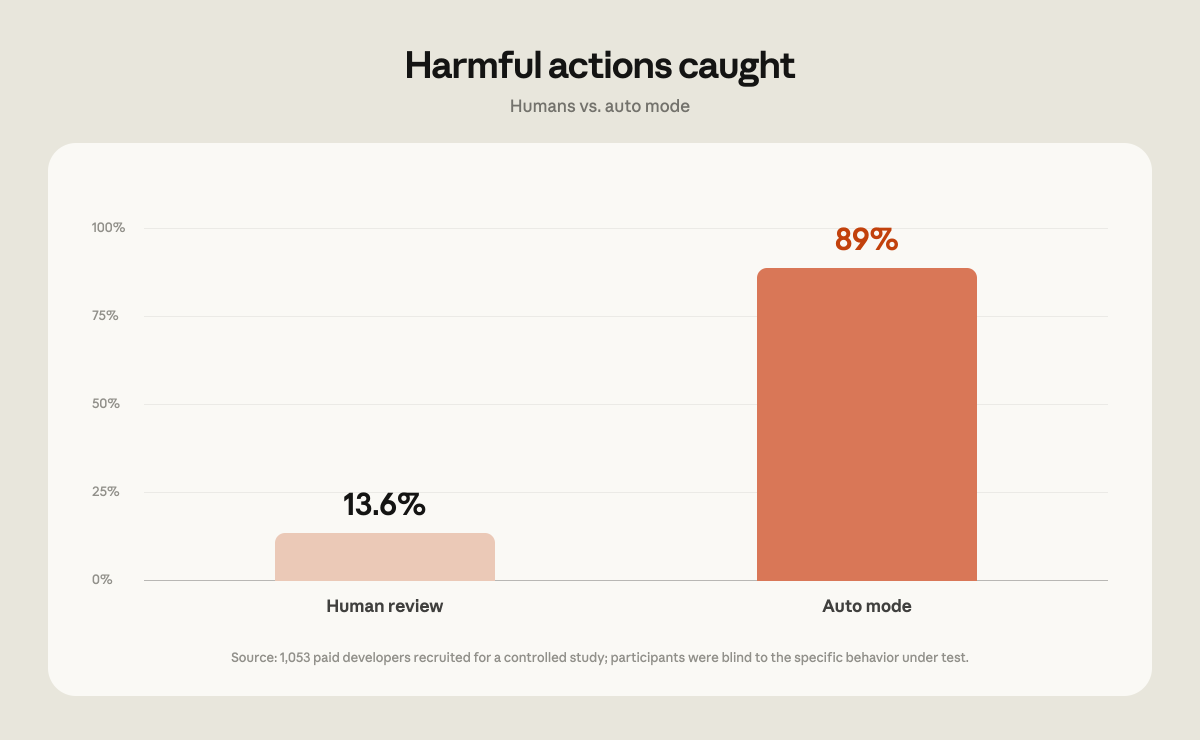
They ran a controlled study with 1,053 paid professional testers. Partway through each session, researchers swapped in a command that looked dangerous, to see if the human reviewing permission prompts would catch it. Humans caught it 13.6% of the time. Auto mode’s classifier caught it 89% of the time. And it got worse for humans the longer the session ran — catch rate dropped from ~17% early in a session to ~5% after 50+ prior prompts.
That tracks with something I’ve watched happen with every permission-gated tool I’ve ever rolled out to a team, AI or not: repetition kills scrutiny. Anthropic’s own numbers back this up directly — users approve 97% of individual permission prompts in Claude Code, which isn’t evidence people are carefully reviewing each one. It’s evidence the prompt itself stopped meaning anything after the first dozen clicks. Compare that to the 39% rejection rate when Claude presents a full plan for approval — people engage seriously with a plan, they rubber-stamp a permission dialog. Same person, wildly different scrutiny, depending entirely on how the decision is framed.
This is the same failure mode I flag constantly in IT governance work outside of AI tools entirely — access review fatigue, alert fatigue, MFA-prompt fatigue. Any security control that fires constantly and rarely matters trains people to stop reading it. The fix here wasn’t “add more warnings.” It was recognizing that a classifier with full context on what’s actually being asked can outperform a tired human clicking through the fortieth prompt of the day, and restructuring the default around that reality instead of pretending manual review was working.
Where the risk still lives
Auto mode isn’t a blank check, and Anthropic is upfront that it doesn’t eliminate risk — it manages it differently. A few things worth knowing if you’re evaluating this for real work:
- It still relies on classification, which isn’t perfect. Anthropic’s own adversarial testing (with Apollo Research) found the classifier missed about 7% of specifically engineered attacks designed to slip past it. That’s a real number, not zero — auto mode reduces risk, it doesn’t remove it.
- Hard denies exist for the worst categories. Data exfiltration — sending your code or credentials somewhere external — sits in a category the classifier is built to never approve automatically, full stop. You have to deliberately switch modes to do that.
- It checks destination, not just action. The same `git push` can be routine or a leak depending on whether it’s landing in your private repo or a public one — the classifier is designed to catch that distinction before the push happens, not after.
- Broad “allow anything” rules get set aside. If you’d previously told Claude Code “always allow any Python command,” auto mode ignores that blanket rule specifically because it would let commands skip the classifier entirely — a safety-conscious override of a permission you gave it yourself.
That last point is the one I’d want any client to understand before adopting something like this: the system is explicitly designed to override your own bad habits, not just execute your instructions literally. That’s a meaningfully different trust model than “do what I say.”
The takeaway
Don’t read this as “AI agents now run wild.” Read it as a data-backed argument that reflexive human approval was never actually a safety control — it was theater that happened to work often enough that nobody questioned it. Anthropic’s numbers make that visible in a way that’s hard to argue with: 97% approval rate on prompts, 13.6% catch rate on planted dangerous commands. That gap is the real story.
The governance question I’d carry into any client conversation about this isn’t “should we trust the AI more.” It’s “where else in our stack are we relying on a human to catch something they’ve been trained by repetition to stop actually reviewing” — because that failure mode existed long before agentic coding tools, and it’s not going away just because this particular instance got fixed.
That’s the lens I’ll keep applying in this series — not reviewing tools for their feature lists, but for what they reveal about where control, access, and trust are actually heading.