Defensibility check: this term is currently more marketing framing than settled technical standard — I’m stripping out vendor pitch language and cross-checking the definition across multiple independent sources rather than presenting any single vendor’s framing as the definition.
“AI control plane” is suddenly everywhere in enterprise AI vendor pitches, tied to product launches like Salesforce’s September 2026 Agentforce 360. Almost nobody defines it plainly. Here’s the actual job the term describes, stripped of the vendor pitch.
The plain-English definition
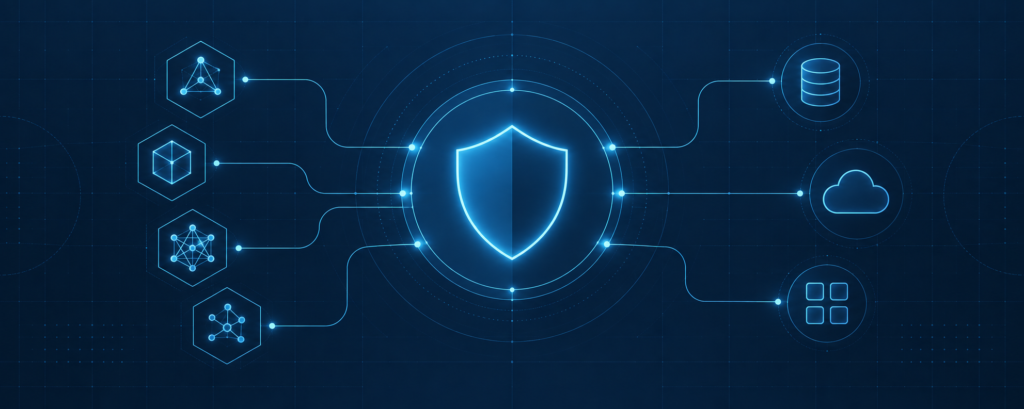
An AI control plane is the governing layer sitting between every AI agent an organization uses and every system those agents are allowed to reach. It’s the single place where identity, permissions, security policy, and activity logging get enforced — so that every prompt, tool call, and response flows through one governed path instead of dozens of ungoverned ones.
The term borrows directly from networking and systems like Kubernetes, which have had “control planes” for years for the same underlying reason: it’s the name for the part of a system that governs the rest of the system, separate from the parts that do the actual work.
Why this became a real problem, not just a buzzword
Most organizations today have AI tools — Cursor, Copilot, ChatGPT, internal agents — spreading across teams faster than anyone can track them, often adopted independently with no IT involvement. This creates what’s commonly called “shadow AI”: tools nobody centrally approved or is watching. Per IBM’s 2026 Cost of a Data Breach Report, 43% of breached organizations traced the incident back to shadow AI — up sharply from 20% the year before.
The tension underneath this: locking AI down too hard kills adoption and pushes people back to personal, unmonitored tools. Leaving it wide open invites exactly the kind of incidents showing up in that breach statistic. An AI control plane is the architectural answer to that tension — not by picking a side, but by making the same layer responsible for both enabling access and enforcing policy on it.
The four things a real control plane actually does
Distilled from cross-checked technical sources (not any single vendor’s pitch):
- Connect — bring every AI agent and every system they’re allowed to reach onto one integration layer, with identity tied through single sign-on rather than personal accounts pasted into random tools.
- Distribute — control who gets access to what, scoped by team or role, with credentials managed centrally instead of hardcoded into config files, and a full audit trail of what was granted to whom.
- Secure — inspect prompts, responses, and tool calls in real time, actively blocking things like personal data leakage or data exfiltration, and feeding into whatever security monitoring tooling already exists.
- Observe — actually measure what’s happening: token usage, tool usage, adoption by team, so leadership has real numbers instead of anecdotes about whether the AI investment is working.
Why point solutions alone don’t cover this
A genuinely useful distinction: several categories of tools already exist that each cover part of this picture, but none cover all of it:
- LLM gateways (routing between model providers) see the model call, but not who triggered it or what tool made the request.
- Tool/agent gateways see the tool-call layer, but not the model layer above or the identity layer behind it.
- Identity providers (SSO tools) know who the user is, but not what AI tools that user is running or what those tools are doing with company data.
- Observability tools record what happened, but can’t enforce policy on it in real time.
- Policy/threat-detection tools can inspect and block traffic, but can’t provision access or manage identity.
The practical implication: an incident that starts with a user logging in, routes through a model gateway, triggers a tool call, and leaks data in the response would leave scattered traces across several disconnected systems with nothing tying them together — unless something sits above all of them as a genuine control plane.
Worth knowing before you evaluate a vendor
“AI control plane” is currently doing double duty as both a real architectural pattern and a marketing term — there’s no single agreed industry standard yet defining exactly what qualifies. When a vendor uses the term, the useful question isn’t “do you have a control plane” — it’s specifically which of the four functions above (connect, distribute, secure, observe) they actually cover, and which ones you’d still need a separate tool for.
The bottom line
An AI control plane is a real, useful architectural concept — the governing layer that ties identity, policy enforcement, and observability together across every AI agent and every system those agents touch. It solves a genuine problem: today’s point solutions each see one slice of AI activity, and none of them alone can connect an incident across the full path from login to model call to tool use to data exposure. Just don’t mistake a vendor’s control-plane pitch for a settled technical standard — the term is still being defined in real time, largely by the vendors using it.
Sources: Speakeasy, “What is an AI control plane?” (published April 2026, updated September 2026); MuleSoft’s AI control plane framing (vendor source, cross-checked only); TrueFoundry’s AI control plane explainer; IBM 2026 Cost of a Data Breach Report.