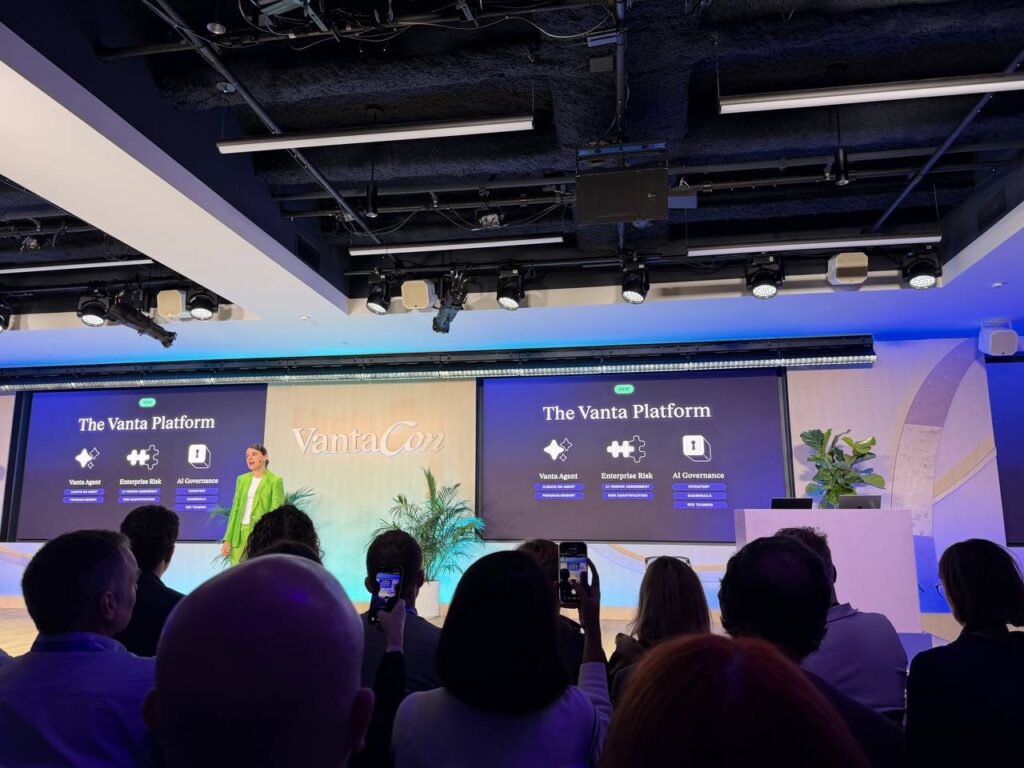
An AI agent can finish a task before a quarterly risk review even notices the task exists. VantaCon’s answer was to connect compliance records, business commitments, agent activity, and security response in one platform.
That is a useful direction. But the most important detail for anyone evaluating the announcements is less theatrical: some capabilities are available now, while significant parts of the runtime-security story remain on the roadmap.
This is a review of the keynote material and Vanta’s public announcements, not a hands-on test of the products. The supplied transcript contains obvious transcription errors; the product names and availability below are checked against linked company sources.
The three announcements, without the stage lights
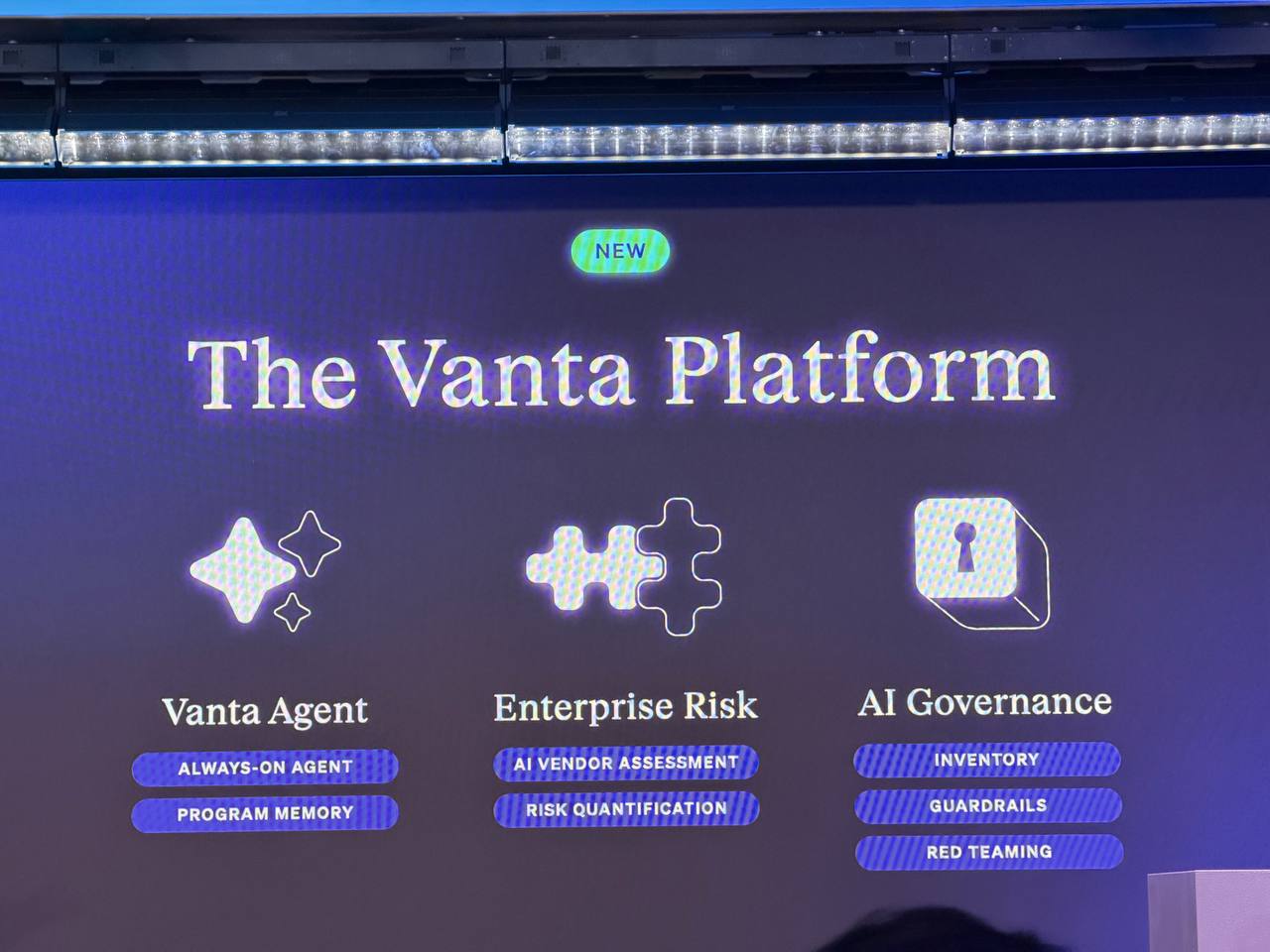
Vanta’s launch page groups the announcements around AI governance, enterprise risk, and the Vanta Agent.
| Area | What the keynote presented | Public availability statement checked November 16, 2026 | Why it matters |
|---|---|---|---|
| Vanta Agent | End-to-end work, program memory, approvals, and coordination in other tools | Launch page labels next-generation automation and “Vanta Where You Work” generally available | Could reduce evidence chasing and repetitive coordination; validate the exact workflow and package |
| Autonomous vendor assessments | Evidence collection, assessments, and reassessment when circumstances change | Launch page labels autonomous assessments generally available | A vendor adding AI can change the original approval assumptions |
| Risk quantification | FAIR-based loss scenarios and financial exposure estimates | Launch page labels risk quantification coming soon | Potentially useful for budget decisions, but an estimate depends on its assumptions |
| AI use cases and assessments | Approved purposes, impact assessments, and links to risks and controls | Launch page labels these generally available | Connects AI adoption to accountable owners and documented decisions |
| AI inventory and runtime detection | Discovering agents, applications, models, and MCP servers | Acquisition announcement targets January 2027 for inventory and monitoring/detection | Coverage and signal freshness will matter as much as the dashboard |
| Red teaming | Adversarial testing linked to business context | Acquisition announcement targets spring 2027 | A planned capability, not a tested outcome from this review |
| Runtime enforcement | Blocking unauthorized agent actions | Acquisition announcement targets summer 2027 | Do not treat the keynote’s intervention demonstration as proof of broad production availability |
These are Vanta’s availability statements and targets, not independent deployment verification. The AI governance FAQ also says current capabilities vary by plan and that inventory and guardrails are coming in a separate paid offering. Get the exact scope in writing.
The Trust Graph is the organizing idea
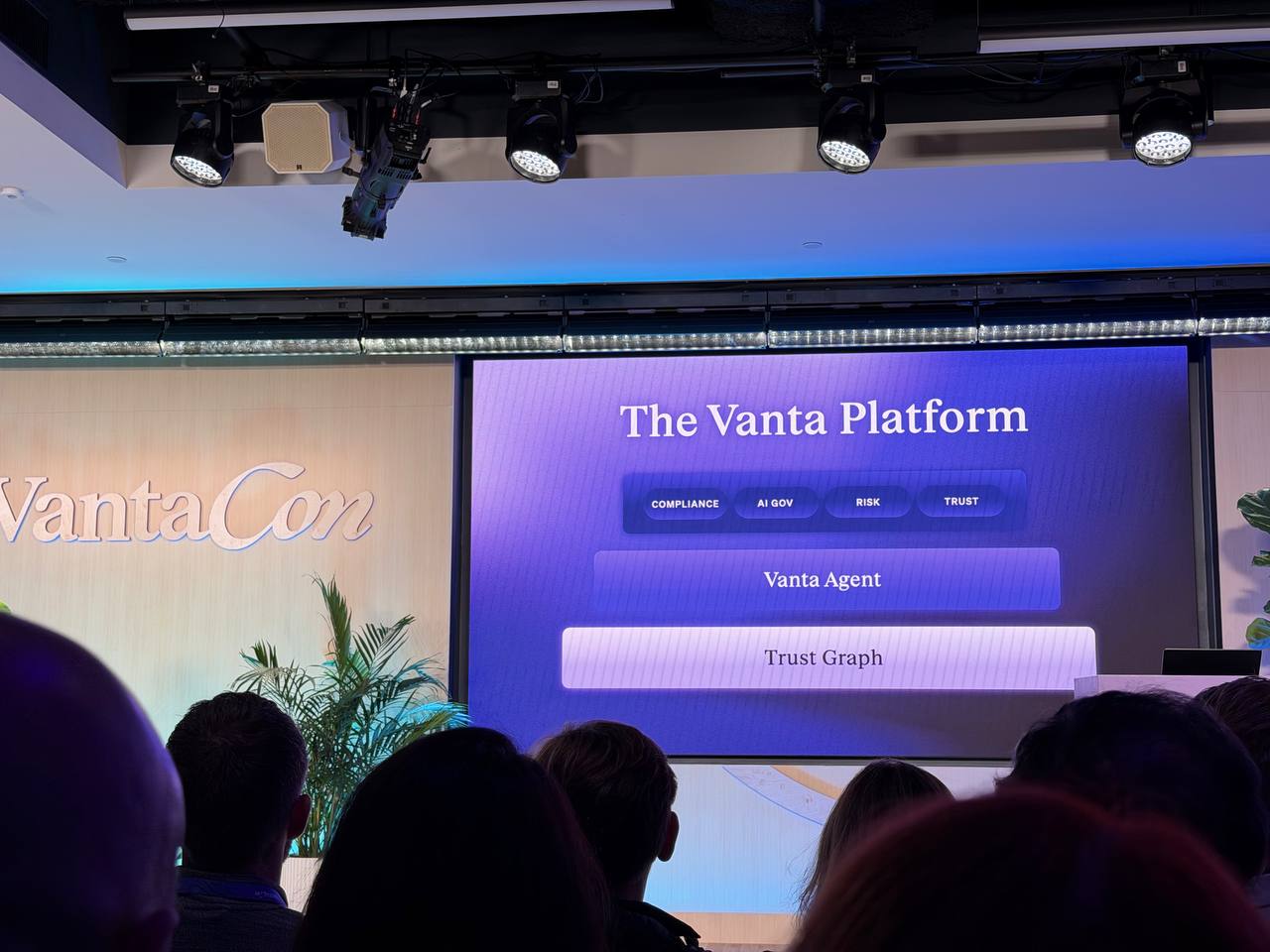
The keynote described the Trust Graph as the connection between controls, policies, evidence, risks, vendors, people, and customer commitments. The proposed advantage is not simply having more records. It is being able to follow a change through those relationships.
Consider the contract demonstration in the supplied transcript, around 24:03–25:20. A sales commitment did not match what the security organization could support. The agent identified the gap and proposed a response involving the agreement and legal coordination.
That is a more interesting use of AI than generating another policy document. A promise made in a contract can create work and exposure for people who never joined the sales call.
It also has a dependency: the connections must be correct. Missing agreements, stale ownership, or incomplete integrations can make a connected view look more complete than it actually is. A graph cannot supply business context it never received.
Evidence collection: useful automation, consequential authority
The audit demonstration, around 22:05–27:09, showed an agent collecting screenshots, pausing for a human-assisted sign-in, and coordinating evidence collection in Slack. It also showed an option to allow future coordination automatically.
The potential benefit is straightforward: less time asking the same people for the same evidence, checking whether it meets the request, and asking again.
But these are different permissions:
- Reading evidence from a defined system.
- Contacting a colleague.
- Reusing an authenticated session.
- Updating an audit record.
- Acting automatically next time.
A product that handles all of them needs more than a friendly approval button. The buyer should understand what each approval grants, how long it lasts, which identity acts, and how to revoke it. A password-manager integration can support safer credential handling; it does not, by itself, establish least privilege or a safe unattended workflow.
The keynote showed these interactions. This review did not independently test their security boundaries or reliability.
Pillar: the proposed bridge from policy to enforcement
Vanta’s Pillar announcement says it signed a definitive agreement to acquire Pillar Security. That wording matters: an announced agreement is not, by itself, confirmation that the transaction has closed.
The intended combination brings runtime protection and adversarial testing together with Vanta’s business and compliance context.
In the keynote demonstration, around 33:33–34:47, an MCP server appeared to be accessing HR records. The presenter showed an alert, ownership context, logging, and a shutdown action. No actual employee records need to be reproduced to explain the lesson: discovering an agent is different from knowing what it can reach—and both are different from stopping it.
There is also a distinction between disabling a connection after detection and blocking a prohibited action before data leaves. The demonstration and roadmap should not be compressed into a single claim that all enforcement is already shipping.
Vanta’s published schedule puts inventory and detection first, then red teaming, then runtime enforcement. That sequence is central to the buying decision, not a footnote.
The agent-to-agent risk deserves attention
In the closing discussion, around 50:16–50:57, a speaker described research involving a public-facing GitHub issue-triage agent and an internal agent with broad cloud privileges. According to the speaker, prompt injection against the public-facing agent could influence the privileged one. The speaker said the researchers reported the issue and helped close it.
That is a reported research account from the keynote, not an independently verified incident in this review. The company was not named, and the supplied excerpt does not establish data theft or the extent of any compromise.
The practical lesson is important nonetheless: a low-privilege entry point can become consequential if another agent treats its messages as trusted instructions. Reviewing each agent separately is not enough; the authority crossing between them matters too.
The closing advice, around 52:22–53:04, gives teams a useful starting point: choose the agent they use most and inspect its identity, permissions, and ability to act without approval.
For an evaluation, turn that advice into five concrete questions:
- Does the agent use a dedicated identity or inherit a person’s access?
- Which systems can that identity read or change?
- Which actions can run without a fresh human decision?
- Can content from another agent or an external source trigger those actions?
- Can the team monitor the activity and revoke the authority promptly?
These are evaluation questions, not claims that Vanta’s announced platform already enforces every boundary. They apply to the GRC agent itself as well as the agents it is intended to govern.
Vendor risk does not stop at onboarding
The vendor-risk example, around 38:42–40:41, concerned an already-approved vendor whose AI product introduced a different use and an unnotified subprocessor.
The important question was no longer simply, “Did we approve this vendor?” It was, “Did we approve this use, with these data flows and these downstream providers?”
Autonomous reassessment could make that distinction operational rather than leaving it inside an annual questionnaire. But detection depends on available signals. A buyer should ask how changes are discovered, what is not visible, and who validates a proposed reassessment.
The keynote’s customer comments and testimonials support the vendor’s narrative. They are not controlled evidence of results that every customer should expect.
Financial risk: a model, not a bill from the future
The keynote’s FAIR-based demonstration, around 40:41–43:59, connected a loss scenario to frequency, susceptibility, cost, treatment options, and supporting business information.
That can make a board conversation more useful than showing a long vulnerability backlog. However, linking a contract to revenue does not establish that all that revenue will be lost. Nor does a modeled reduction in exposure automatically equal realized return on investment.
A defensible output should show:
- The specific loss scenario and time horizon.
- Ranges and uncertainty, rather than only a precise-looking number.
- Assumptions, evidence sources, and confidence.
- The baseline and treatment scenario.
- Who reviewed the estimate and when.
The value is in making a decision more explicit—not in making uncertainty disappear.
Agentic Trust Controls: a separate, practical deliverable
Vanta also presented Agentic Trust Controls as an open-source community effort. Its public control page describes controls covering identity, tool use, instruction integrity, memory, delegation, human oversight, monitoring, supply chain, adversarial testing, output integrity, resource abuse, and accountability.
The useful distinction is between organizations building agents and organizations deploying agents built by somebody else. Both need governance, but their responsibilities are not identical.
A control catalog is not evidence that every control is implemented. Its practical value comes from assigning owners, defining the expected behavior, and collecting evidence that the behavior actually holds.
From the field
What impressed me most was the potential: if everything Vanta announced works as presented, it would be amazing. My reservations are the add-on costs for the individual modules and how the system actually works in practice. I want to see a full demo before drawing a firm conclusion.
Verdict: a coherent direction, with a staged delivery story
The keynote connected work that organizations often manage separately: audit evidence, vendor changes, contractual commitments, AI permissions, incident response, and business risk.
Its strongest proposition is that those relationships should inform action. Its biggest unresolved question for a buyer is how much of that loop is available for their environment now, and how much depends on future releases and integration coverage.
Treat this as a platform direction worth evaluating—not a declaration that agent security is solved. Ask for the available workflow, the approval boundary, the evidence trail, and the delivery schedule.
For the commercial evaluation, request an itemized quote showing which modules are included, which cost extra, and whether the demonstrated workflow requires multiple paid offerings. The FAQ establishes plan differences and a forthcoming separate paid offering; it does not establish an extra charge for every module. Then ask for a full demonstration of the workflow you would actually use, including the human approvals, exceptions, and audit trail—not just the successful path.
News disclaimer: This analysis draws on supplied keynote material and linked public vendor announcements. Product descriptions and delivery targets are vendor statements, not independently verified performance guarantees. It does not report an employer or client deployment.
Sources
- VantaCon launch announcements and availability labels
- Vanta’s Pillar acquisition agreement announcement and delivery roadmap
- AI governance product FAQ: current capabilities, plan limits, and forthcoming offering
- Agentic Trust Controls
- Owner-supplied keynote summary and transcript excerpts; timestamps above refer to those excerpts.