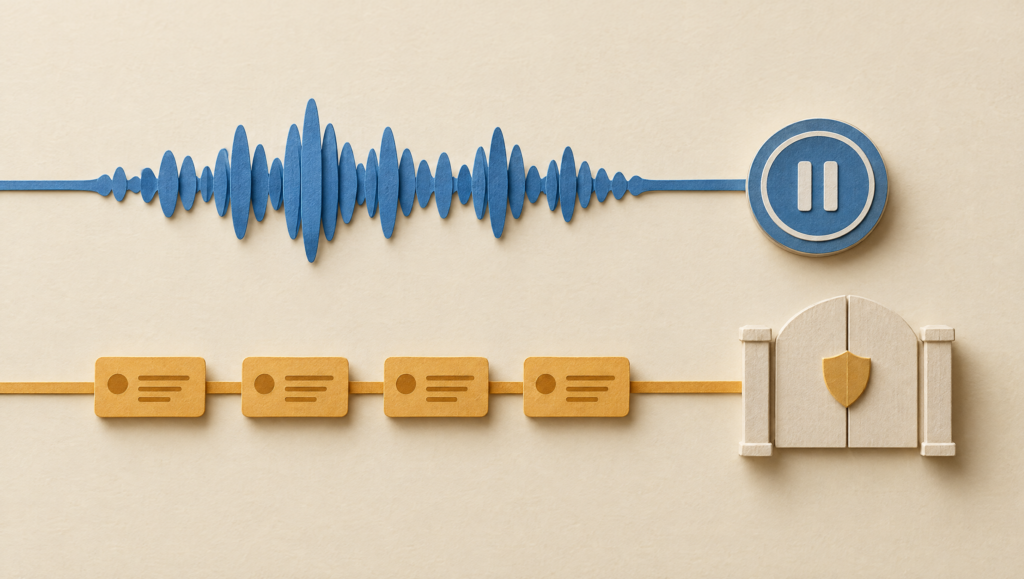
Picture this: you ask a voice assistant to send a message. While it reads the message back, you spot a mistake. “Wait. Stop.”
The voice goes quiet. Relief—until the obvious question catches up: did it stop the message, or just the sentence?
This is an illustrative scenario, not a personal incident or a report of a product failure. It gets to a practical question worth asking before giving any assistant permission to act.
The short answer: interrupting a voice assistant is not necessarily the same as cancelling its task. In OpenAI’s GPT-Live documentation, speech and background work are separate, and interrupting speech does not automatically cancel that work. The application must handle permissions, confirmations, and the task’s lasting record.
The voice is the front desk. The work happens elsewhere.
Think about calling a hotel. You can interrupt the person explaining your reservation while another system is processing it. The conversation stopped; the reservation may not have.
That is a useful analogy for the separation described in the GPT-Live guide: the voice layer handles conversation, while a backend—software working behind the scenes—uses tools and completes tasks. It is not a claim that every voice assistant uses this architecture.
The important question is not how natural the voice sounds. It is whether the application connects your instruction to the action you meant to stop.
“Stop” can mean several different things
Here is a practical vocabulary for evaluating an assistant. These are suggested distinctions, not standardized button names.
| Control | What you want it to do | What it does not prove |
|---|---|---|
| Mute or interrupt | Stop the audible response. | That the task was cancelled. |
| Cancel | Prevent work that has not yet completed. | That an already-completed action was undone. |
| Undo or recover | Reverse or compensate for an action where possible. | That every copy, notification, or downstream effect disappeared. |
A task can cross the finish line while a cancellation request is still travelling. That is why I would judge the response by the evidence it provides, not by the confidence of its tone.
What a useful answer sounds like
Compare these proposed responses:
- “I stopped speaking. The task is still running.” Clear, even if it is not the outcome you wanted.
- “Cancellation requested. I’m checking whether anything was sent.” Honest about an unresolved result.
- “Cancelled before sending. Nothing was sent.” Appropriate only after the application verifies that state.
- “It was already sent. Here is the confirmed status and the recovery option.” Acknowledges the limit instead of pretending time runs backward.
These are examples of desirable wording, not transcripts or promises about a particular service. An assistant should not say the reassuring version just because that is what the user hoped to hear.
Before you let it book, buy, or send
Ask the provider to demonstrate a low-risk test task. You do not need to inspect code to ask useful questions:
- Where is the final approval? Can you review the exact recipient, item, or change before it happens?
- What does cancellation affect? The voice, the pending action, or both?
- How is the result checked? Does “done” come from the service that performed the action, or just from the assistant’s summary?
- What happens when the connection drops? Will the task resume, stop, or show an uncertain status?
- What prevents duplicate attempts? If the result is unknown, can it check before trying again?
This checklist is my suggested evaluation approach. It aligns with OWASP’s guidance on action previews, explicit approval for high-impact actions, and independent validation before execution; it is not a certification test.
If you have already said “stop”
Ask for the status of the specific action, not another explanation of what the assistant intended. If a booking or message may already exist, inspect the destination service or its confirmation before repeating the request.
For a team building an assistant, the practical design lesson is to show requested, running, cancellation requested, and confirmed result as distinct states. A visible record is more useful than a silent screen. The record should make clear what was requested, what was authorized, and what actually happened.
Questions readers usually mean
Does closing the app stop the task?
Do not assume so. The behavior depends on the application. Ask whether closing a session cancels delegated work and how to verify the outcome.
Is this a flaw in every voice model?
No. The cited documentation describes an application-design responsibility. It does not establish that every product mishandles cancellation.
Can every action be undone?
No universal promise is sensible. A draft can often be discarded; a delivered message or completed transaction may have consequences that a later reversal cannot erase.
From the field: Well, the AI should confirm that I asked it to stop and ask me what would I like to do next and confirm what has been done. All depends on if already been booked, ask me if I want to cancel it and also even let me know what are the consequences if I cancel. Will there be cancellation fees? Will it be easy to book the replacement flight/booking? Reason with me and act like a professional travel agents.
The standard worth asking for
“I heard you” and “I stopped the job” are different answers. Before trusting an assistant with a consequential action, make sure you can tell which one you received.
News Disclaimer: Facts in this article reflect publicly available product documentation checked September 13, 2026. The scenarios and proposed responses are illustrative, not reported incidents or hands-on test results. Product behavior and requirements may change. Verify current status before relying on a claim.
Featured image: AI-generated conceptual illustration using GPT Image 2.5 via Higgsfield; not a product screenshot or documentary photograph.