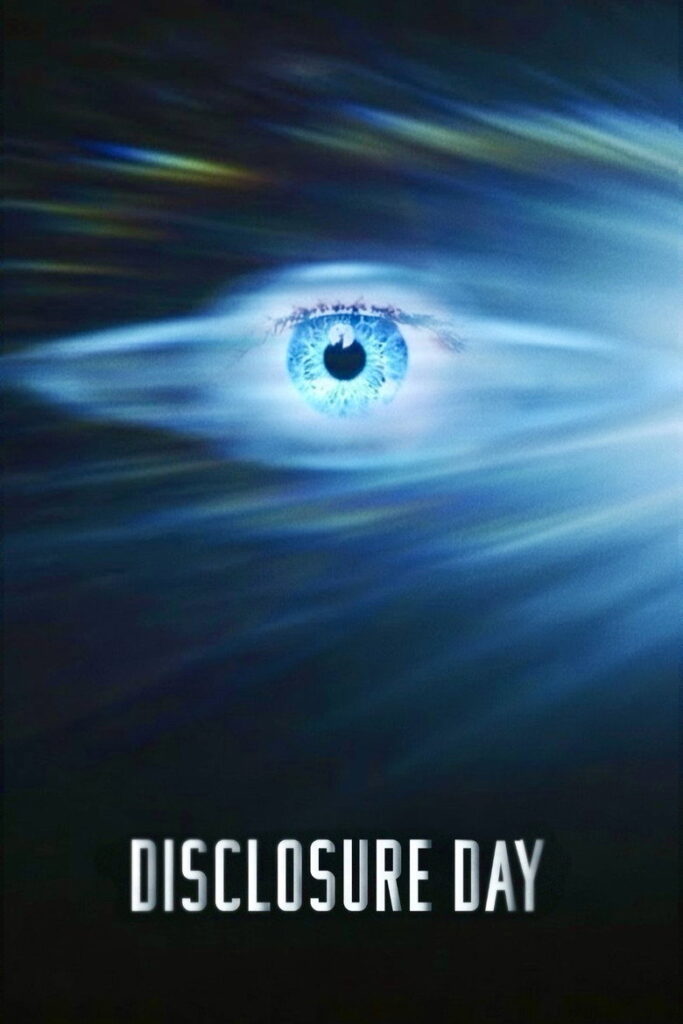
I watched Disclosure Day in a movie theater in Jakarta on a Friday night. The audience was mostly local — the kind of crowd that claps at the good parts and goes completely silent when the film demands it. And for the last ten minutes of this movie, you could hear nothing.
Then Emily Blunt turned to the camera, looked directly into it, and said one word.
“Listen.”
Cut to black. Credits roll.
I’ve been thinking about it ever since. And based on how many people are searching for answers right now, I’m not alone. Here’s everything you need to know — what happens at the end, what the alien actually whispers, what “Listen” means, whether there’s a post-credit scene, and what it all points to next.
What Happens at the End of Disclosure Day
⚠️ Full spoilers below.
The final act takes place at KCXE, a small fictional television station in Kansas City. Meteorologist Margaret Fairchild (Emily Blunt) and whistleblower Daniel Kellner (Josh O’Connor) have managed to upload 79 years of classified Wardex Corporation footage onto the broadcast servers — evidence of alien contact stretching back to the 1947 Roswell crash.
Wardex cuts the power grid. Margaret channels a piece of stolen extraterrestrial technology to restore the signal. Wardex chief Noah Scanlon watches his decades-long cover-up collapse on live television.
Hugo’s resistance group then wheels a living extraterrestrial — designated In Vivo 17 — onto the broadcast stage in front of a global audience. The alien is tall. It communicates to Daniel via a rapid sequence of clicks and 8-bit binary tones — a mathematical language Daniel can decode because of neurological alterations made during a childhood abduction, alterations he shares with Margaret.
Daniel relays the translation to Margaret. She processes it. She walks back toward the camera — breaking the fourth wall, addressing not just the fictional world but the actual audience in the theater.
And she says: “Listen.”
Cut to black. The John Williams score swells. Credits.
What Does the Alien Whisper?
This is the question every viewer walks out asking.
The film deliberately withholds the full message. Spielberg and screenwriter David Koepp have confirmed the alien’s complete communication exists — they wrote it — but chose to give the audience only the first word.
Josh O’Connor (Daniel) told GamesRadar+ that he knows the exact translation. His answer: “Yes… and I’m not going to tell you.”
What the film does confirm: the alien communicates in mathematical language — clicks and binary tones; the message is long enough that Daniel has to relay it in stages; and Margaret’s reaction — composed, certain, moved — suggests it is not a warning or a threat. It reads more like an answer to a question humanity has been asking for millennia.
What Does “Listen” Actually Mean?
There are three layers to this word, and Spielberg almost certainly intended all three simultaneously.
Layer 1 — The literal first word of the alien’s message
“Listen” is the opening instruction of whatever the alien communicated. It is what Daniel translated, and what Margaret passed on to a global audience. The film ends mid-sentence — we get the instruction to receive, but not yet what we are meant to receive. This is either a deliberate sequel setup or a permanent open ending.
Layer 2 — A direct address to the real-world audience
IGN confirmed that Spielberg deliberately blocked the shot so Blunt looks directly into the camera — not at the fictional TV audience, but at us. She is telling the person in the theater to listen. To each other. To science. To reason. To truth. The film is set against near-WWIII tensions on the Korean peninsula, a world fracturing along ideological lines — and the alien’s first word to that world is not “peace.” It’s an instruction about how to receive what comes next.
Layer 3 — The thematic payload of the entire film
Screenwriter David Koepp confirmed to Den of Geek that the “Listen” scene was the first scene Spielberg wrote. The entire film was built backwards from that moment. The story is not about whether aliens exist — the film never questions that. It’s about what humanity does with irrefutable proof. The alien’s opening word reframes everything: whatever answer humanity has been waiting for is conditional on whether humanity can first stop talking and start listening.
Is There a Post-Credit Scene?
No. Disclosure Day has no post-credit scene. The credits roll with John Williams’ score and nothing follows. This continues Spielberg’s 52-year tradition of never including post-credit scenes. You do not need to stay seated.
What Happens Next? Sequel Speculation
Spielberg has not confirmed a sequel. But several things point toward one being considered:
- The alien’s message is unfinished. “Listen” is the opening word. The rest exists — Koepp and Spielberg wrote it. The deliberate withholding reads like franchise architecture.
- O’Connor knows the full translation and was clearly instructed not to reveal it. Actors aren’t typically given complete alien-language scripts for standalone films.
- The world’s situation is unresolved. The film ends at the moment of disclosure — not after it. Noah Scanlon is still alive. Wardex’s global reach is unaddressed. The story of what happens after humanity learns it is not alone is entirely untold.
- The box office makes a sequel inevitable. The film opened to an estimated $94 million domestic against a $145 million budget, with strong international receipts including significant numbers out of Southeast Asia.
My speculation: The rest of the alien’s message is a coordinate — a location, a time, or an invitation. “Listen” is the preamble to a rendezvous. The sequel begins with humanity deciding whether to respond.
What the Critics Are Saying
Disclosure Day currently holds an 80% on Rotten Tomatoes (Certified Fresh). The critical consensus is broadly positive — Spielberg’s return to blockbuster form, strong performances from Blunt and O’Connor, and a finale that lands its emotional and thematic ambitions. The common criticism is a slow first half. The common praise is that it earns every minute of that setup.
The ET comparison holds. The DNA is identical: ordinary people thrust into contact with something that fundamentally changes their understanding of the universe. Disclosure Day is more political and more adult than ET, but the core emotional machinery — wonder, fear, the moment of genuine connection across an impossible distance — is the same.
My Take (Watched in Jakarta, June 2026)
The theater I was in went completely still for the last fifteen minutes. That doesn’t happen often.
The “Listen” ending will divide people. Some will find it unsatisfying — they came for answers and got an instruction. Others will find it exactly right. The aliens have been here since 1947, the film argues. They’ve been watching us. And when they finally get a chance to address the whole species at once, the first word they choose is not “hello” or “we come in peace.”
It’s listen.
That is either a pointed comment on the state of humanity in 2026 — a world that cannot stop arguing long enough to hear anything — or it is a universal constant about intelligence itself: that the precondition for real communication is the willingness to receive.
I think it’s both. And I think that’s why the film cuts to black right there, before the next word. Because the next word isn’t the alien’s job. It’s ours.
Frequently Asked Questions
Does Disclosure Day have a post-credit scene?
No. There is no post-credit scene. Spielberg has never included one in any of his films.
What does the alien whisper to Daniel in Disclosure Day?
The alien (In Vivo 17) communicates via clicks and binary tones. Daniel translates it for Margaret. The full message is deliberately withheld — only the first word, “Listen,” is delivered to the audience. Josh O’Connor says he knows the translation but won’t reveal it.
What does “Listen” mean at the end of Disclosure Day?
It works on three levels: the literal first word of the alien’s message; a direct Spielberg address to the real-world audience; and the film’s central theme that the precondition for contact is the willingness to receive. Koepp confirmed “Listen” was the first scene Spielberg wrote — the entire film was built around it.
Will there be a Disclosure Day sequel?
No official announcement yet, but the strong opening weekend, unresolved alien message, and O’Connor’s knowledge of the full translation all suggest a sequel is at minimum under serious discussion.
Is Disclosure Day based on a true story or book?
No. It is an original screenplay by David Koepp based on a story by Steven Spielberg.
Disclosure Day (2026) is directed by Steven Spielberg, written by David Koepp, and stars Emily Blunt, Josh O’Connor, and Colman Domingo. Distributed by Universal Pictures. In theaters now.