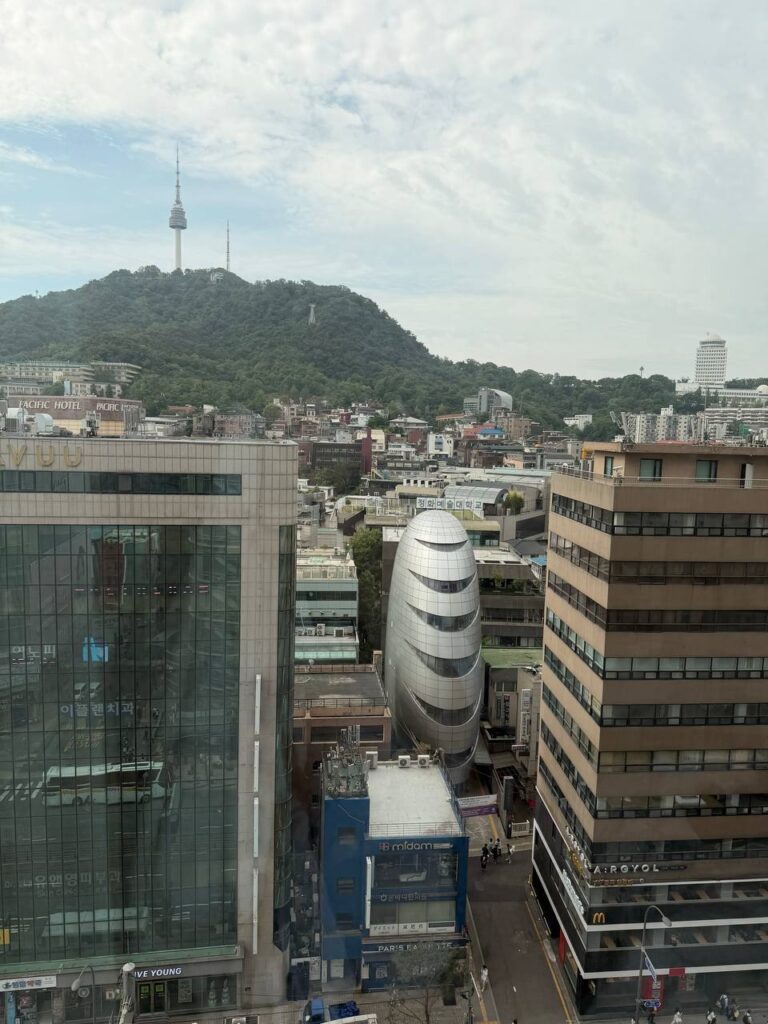
From my hotel window in Myeongdong, I spotted what looked like a silver spaceship parked between two ordinary office buildings.
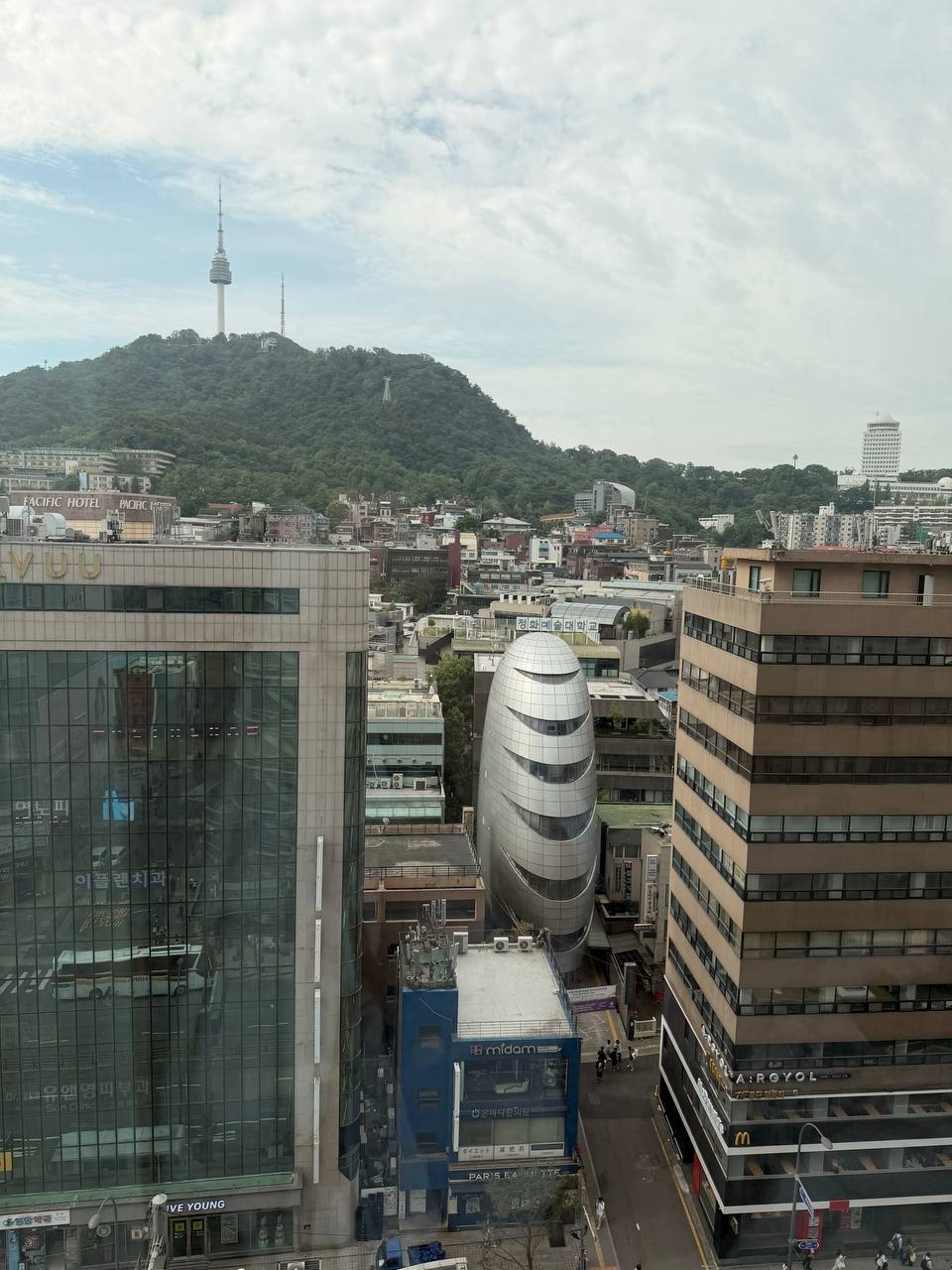
Not metaphorically. Literally: a smooth, ribbed silver pod — horizontal bands of reflective metal, an egg-shaped silhouette — rising eight stories out of the Myeongdong streetscape like it had been dropped there from somewhere else. Behind it, Namsan mountain and N Seoul Tower. In front of it: a McDonald’s.
The contrast was so complete it felt staged.
The Investigation
The building has no obvious ground-floor identity from a distance. No large commercial signage. No logo you’d recognize. Just the silver surface, the horizontal bands, and the unmistakable impression that this was either the most interesting building in Myeongdong or a set piece from a film that used Seoul as a backdrop.
Pulling up Naver Maps revealed the answer: 정화예술대학교 — Jeonghwa Arts University, Myeongdong Campus.
Not abandoned. Not a tech company headquarters. Not a hotel. An art school.
An art school that had been operating in this exact spot since the university’s founding in 1951 — when it opened as Korea’s first beauty education institution. More than seventy years of arts education, hidden in plain sight inside what looks like a visitor from another decade of architectural optimism.
The Building and What It Says About Seoul
The specific architect and construction date of the current Myeongdong campus building remain difficult to verify — it doesn’t appear in English-language architectural databases, and I’m not going to speculate. What’s visible in the photo is enough: the building is deliberately, aggressively unlike its neighbors.
This is a pattern in Seoul. The city has a history of treating buildings — especially institutional ones — as identity statements. In a hyper-competitive urban district like Myeongdong, where every storefront competes for visual attention and the streetscape is a constant negotiation between brands, a university that looks like it arrived from 2040 is making an argument.
The argument is: we are not a conventional institution.
Jeonghwa Arts University runs programs in beauty, performance, and applied arts. In Korea, beauty is both a serious cultural industry and an academic field. The school that pioneered beauty education in 1951 chose, at some point, to house itself in a building that looks like the future of the field — not its history.
Seoul’s Layered Time
What makes the building genuinely interesting isn’t the building itself. It’s the context.
The buildings immediately surrounding it are from a different architectural era — 1970s and 80s commercial Seoul, beige and brown concrete, the kind of structures that get described as “utilitarian” by people being generous. Functional. Durable. Unremarkable.
The silver pod sits between them like a typographical error. Or like something that knew what it was doing.
This collision of eras is one of Seoul’s defining characteristics. The city doesn’t preserve its old buildings the way Bukchon preserves its hanok. It doesn’t sweep entire districts into uniform modernity either. Instead, it layers — each decade adding its architectural vocabulary on top of the previous one, sometimes elegantly, sometimes violently, always creating something stranger and more interesting than either would be alone.
You walk through Myeongdong expecting a shopping district. You get a shopping district with a spaceship in it, and Namsan mountain behind that, and a McDonald’s below, and N Seoul Tower catching the light above everything. It shouldn’t work. It does.
Look Up
Most of Myeongdong is experienced at ground level — the cosmetic shops, the street food, the cosmetic shops, more street food. The silver building is invisible from the main shopping street. You only see it from an elevated angle: a hotel window, a rooftop café, a higher floor of one of the adjacent buildings.
That’s the invitation Seoul keeps extending to anyone willing to take it: look up. Look past the storefront. Look past the obvious layer of the city and find the one underneath — or above — or squeezed between two decades of concrete that weren’t paying attention to each other.
The spaceship was there the whole time. Most tourists walk past it without ever knowing.
📍 정화예술대학교 (Jeonghwa Arts University) Myeongdong Campus — 남산동1가, Jung-gu, Seoul
Founded 1951 as Korea’s first beauty education school. Active campus as of May 2026.
Specific architect and build year of current structure unconfirmed — corrections welcome.
Seoul 2026 — Field Dispatches
The Village That Seoul Built Around Itself — Bukchon Hanok Village
The Neighborhood That Feels Like Somewhere Else — Anguk + Café Jinsun
The Alley That Hasn’t Changed Since the War — Jongno Fish Alley
₩17,900 and the City That Doesn’t Go Home — Hongdae BBQ
Seoul Transit Reality Check — T-Money, WOWPASS, Uber
→ The Spaceship Hidden in Myeongdong (you are here)
📬 Follow the field dispatches
Observational travel writing, AI-assisted field notes, and the things most tourists walk past. Seoul and beyond.